
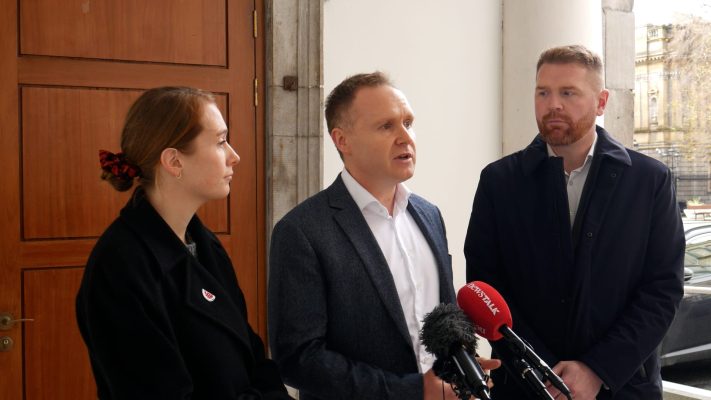
The quiet phasing-out of early intervention classes for autistic children is being presented by Government as inclusion, when in reality it amounts to an essential provision being scaled back to meet shortages elsewhere, according to Social Democrats disability spokesperson Liam Quaide.
Deputy Quaide said:
“I received a parliamentary reply which shows that the Department of Education and the National Council for Special Education are encouraging schools to repurpose early intervention classes to meet wider special class demand.
“Early intervention classes are a pivotal part of the continuum of support for autistic children who are not yet ready to transition to a special class, or into school more generally.
“Yet there is an insidious pattern emerging in the treatment of these classes. They are being slowly but surely phased out under the guise of inclusivity. On paper, we are told this is about inclusion and about meeting need. In practice, what this means is one essential form of provision being scaled back to meet pressure elsewhere; a classic case of ‘robbing Peter to pay Paul’.
“The Government is getting away with this because it is happening incrementally, under the radar, and because the group of children affected at any given time is relatively small. Presenting this as inclusivity is not just misleading; it is deeply cynical.
“A class that should be there for a new cohort of children is instead being absorbed into the primary system to patch over shortages elsewhere. Early intervention classes can be the bridge into education for children who need intensive support at the earliest stage.
“These classes can help children develop communication, regulation, routine and the core skills needed to engage with school life.
“Investment at that stage can yield enormous benefits later in a child’s education and development. If we hollow out that provision, we will leave some of the most vulnerable young children without the support they need at the very point when early intervention matters most.
“The national figures point in the wrong direction. After previous growth, the total number of early intervention classes fell from 157 in 2024/25 to 149 in 2025/26.
“Cork shows the wider pattern very clearly. Instead of strengthening early intervention provision, there is a clear reduction over time, with six fewer early intervention classes now than existed in 2020. This is deeply concerning, and the trend must be reversed.
“Government should not be preaching about inclusive education while quietly reducing access to early intervention provisions that many children depend on in order to access education in the first place.
“The Minister must now acknowledge the distinct and irreplaceable value of early intervention classes, commit to protecting them from routine re-designation, and set out how the number of these classes will actually be increased rather than gradually eroded.”
April 27th, 2026